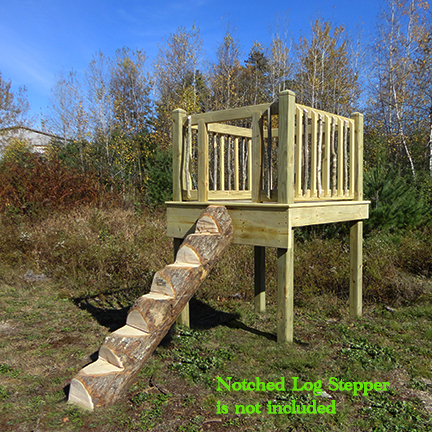
Children absolutely LOVE heights, so it is no wonder they find this Watch Tower so attractive.
Watch Towers were commonly constructed near Native American gardens so that members of the tribe could watch for crows, deer, and other unwanted critters trying to take their crops, so when we designed and built a Natural Playground oriented around the Sisseton Wahpeton Oyate in South Dakota, where everything in the play area was completely, authentically, Native American, we constructed a Watch Tower -- and the kids loved it!
You’ll need a way to access the Garden Watch Tower! Access can be provided by our Notched Log (shown here, but not included), our climbing wall, or by a cargo net, a ladder, and so on. As with any raised play element, the Tower needs a fall zone 6’ out from its perimeter all around it. If you add play elements that stick out, the fall zone has to extend 6’ from all sides of those elements, as well.
The railing is 38” high.
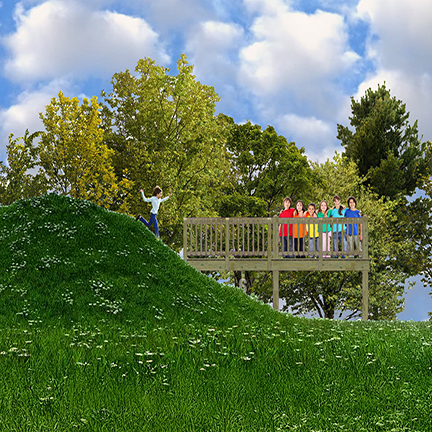
This Watch Tower, with its 4’x4’ or 6’x6’ deck, is a very versatile play element that can be used as a tree house, can be built into the side of a hill to provide a deck (no fall zone needed on that side), or can be used as an overlook if you have a steep slope on your property (no fall zone needed on the downside of the hill, as this is now a deck and not a play element (though kids will probably play on it).
Make sure you choose the height for your Garden Watch Tower!
TREE DECK BRIDGES:
Many of our customers had installed a Watchtower near a hill, and thought it would be great if the hill could be connected to the Tower!
We now offer the perfect bridge, hill-to-tower, tower-to-hill!
The one shown in the image is 3’ wide and 7’ long, but we can make it any length you want (well, not to the moon... :), so just let us know what you’re trying to do.
NOTE That , as with all wood products, some shrinkage (which will cause boards to separate from one another), checking, and cracking may appear as the wood dries out. This will not affect the structural integrity of the product, but does provide an excellent learning opportunity for the children. You can help them understand what happens to wood after it is no longer being fed by the tree that grew it.
You are encouraged to sand any rough spots whenever they appear, and retreat them with child friendly preservative (sold in our store) at least twice a year.
Although it is not necessary, some people like to fill cracks in wood with exterior wood putty followed by sanding and treating.
Please specify height required.